


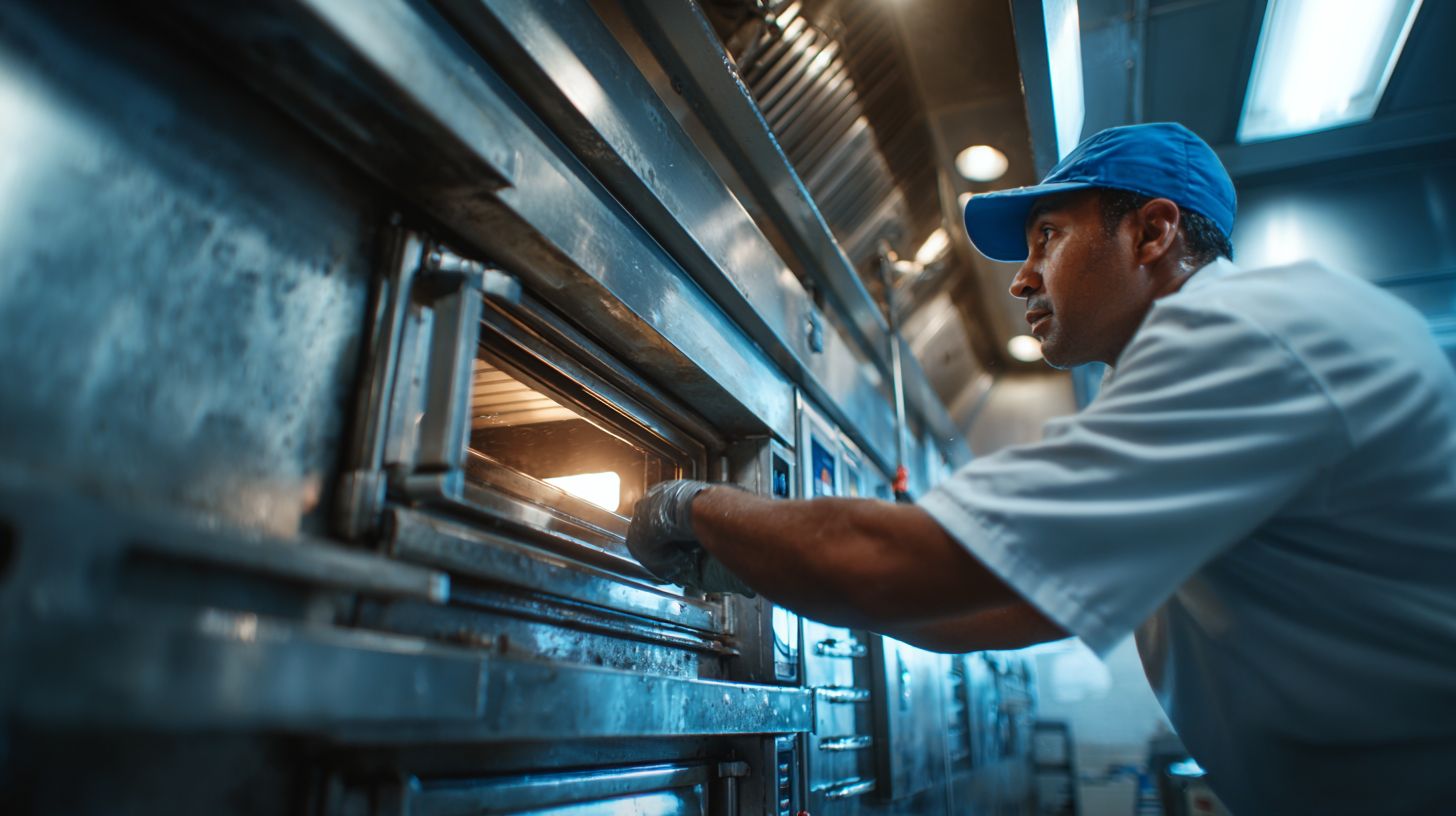


There is a version of hood cleaning that most kitchen operators are familiar with. The crew arrives, the filters come out, the visible interior surfaces of the hood get scrubbed, and the kitchen looks cleaner than it did before. The service certificate gets filed. The next cleaning date gets marked on the calendar. And from the cooking floor, everything looks the way it is supposed to look.
What that picture misses is everything that is not visible from the cooking floor. The grease that left the fryer or the charbroiler three hours into service did not stop moving when it reached the plenum. It traveled. It coated the interior walls of the duct run across every foot between the hood and the rooftop fan. It accumulated on the fan blades, in the housing, in the grease collection components at the top of the system. It settled into seams and corners and on the motor-adjacent surfaces that heat and proximity to the exhaust stream make particularly prone to deposit buildup.
That portion of the system, the portion that is not visible from the cooking floor and that does not look different from one week to the next because nobody is looking at it directly, is where the most consequential accumulation happens. Understanding what is happening inside the exhaust system between cleanings is the foundation for understanding why the cleaning scope matters as much as the cleaning interval, and why the two decisions together determine how much protection the kitchen actually has.
The journey grease takes from the cooking surface to the rooftop is not a simple one, and the physics of that journey explain why different parts of the system accumulate at different rates and why some sections present significantly greater risk than others when accumulation is left to build.
When cooking equipment generates heat, it creates an upward air movement that carries grease-laden vapor toward the hood. The exhaust fan above reinforces this movement, drawing air from the cooking zone through the hood opening, into the plenum, and through the ductwork toward the exterior. Grease vapor that is drawn into this airstream does not behave like water moving through a pipe. It moves with the air, but it also interacts with the surfaces it passes over.
Wherever the airstream changes direction, slows, or encounters a surface cooler than the vapor itself, grease deposits begin forming. Duct elbows and transitions are particularly prone to accumulation for this reason. The inner corners of horizontal duct runs collect deposits differently than the outer edges. Areas where air velocity is lower, typically in wider sections of the duct run, see heavier deposits than high-velocity sections. The fan housing, where airflow changes direction dramatically as it passes through the fan blades and into the discharge area, is one of the most significant accumulation points in the entire system.
This is why a complete kitchen exhaust hood cleaning service that accesses every section of the system produces a meaningfully different result than one that addresses only the lower portions of the system accessible from the cooking floor. The cleaning is addressing different accumulation conditions at different points, and those conditions change based on where in the system each section sits.
Fresh grease deposits inside an exhaust system are relatively soft, somewhat fluid, and easier to remove than deposits that have been in place for longer periods. That is the condition that a kitchen on an appropriate cleaning schedule is managing when service occurs. The deposits are present, they are building, but they have not had time to undergo the changes that make them more hazardous and more difficult to address.
Grease that remains in a warm exhaust system across multiple cooking cycles undergoes oxidation. The lighter, more volatile components of the deposit evaporate over time, leaving behind a denser, more viscous residue that adheres more strongly to duct surfaces and is significantly harder to remove than fresh grease. This is the deposit condition that technicians encounter in kitchens that have extended well beyond their appropriate cleaning interval — not soft, wipeable grease but oxidized, adhesive buildup that requires substantially more effort to address and that has been developing the reactive qualities that make it a fire risk.
Extended accumulation also means deeper deposits. What begins as a thin coating on duct walls becomes a layered buildup that reduces the interior cross-section of the duct, increasing resistance to airflow and progressively degrading the system’s ability to move the volume of air it was designed to handle. The fan compensating for that increased resistance is a fan running harder than its design parameters intended, and the mechanical consequences of that sustained overwork are the bearing and motor wear patterns that show up in facility repair and maintenance costs long before they are recognized as exhaust system consequences.
The temperature characteristics of duct deposits also change with age. Fresh grease has a relatively high ignition temperature. Oxidized, layered deposits have lower ignition thresholds, and the surface area available for ignition increases as deposits grow. A fire that originates in the duct system of a kitchen with heavily accumulated deposits has access to more fuel across more surface area than the same fire in a maintained system, and suppression systems designed to control a kitchen fire are not engineered to manage a sustained duct fire fed by extensive accumulated fuel.

There is a pattern in how hood cleaning gaps develop, and it follows the simple logic of accessibility. The sections of the exhaust system that are easiest to reach from the cooking floor get cleaned most consistently. The sections that require deliberate access, specialized equipment, or work on the rooftop are the sections that are most likely to be incompletely addressed when service is either rushed or delivered by a provider who is not covering the full system scope.
The duct interior is the primary gap. A plenum that has been wiped down and filters that have been degreased can give the appearance of a completed service while the interior of the duct run from the plenum to the rooftop fan contains months or years of accumulated deposits that no part of the service reached. This is particularly common in systems with long or complex duct runs where access requires cutting and resealing access panels or working from multiple entry points.
The exhaust fan housing is the second most commonly missed section. Located at the top of the duct run, typically on the roof or in a mechanical space above the kitchen, the fan housing accumulates grease on the blades, on the housing interior, and in the grease collection trays around the fan base. Fan blades that are coated with grease deposits become unbalanced, vibrating in ways that accelerate bearing wear. The motor operating in proximity to accumulated grease runs warmer than it should. Neither condition is visible from the cooking floor, and neither produces an obvious alarm until the mechanical consequences reach a point of failure.
Rooftop grease collection and the discharge surfaces around the fan outlet are the third commonly incomplete section. Grease that exits the exhaust stream at the discharge point accumulates on rooftop surfaces, on curbing around the fan housing, and on drainage components designed to capture it. When those components are full or the drainage is obstructed, grease overflows onto roofing materials, accelerating their degradation and creating a secondary ignition risk at a location entirely removed from the kitchen’s fire suppression coverage.
Understanding what happens to a commercial kitchen when hood cleaning gets delayed makes the consequences of these missed sections concrete rather than abstract.
The difference between a surface cleaning and a complete hood cleaning service is the difference between managing the visible portion of the system and managing the system as it actually exists. That distinction matters practically because the risk and performance consequences that drive the case for consistent hood cleaning are located in the portions of the system that only a complete service reaches.
A thorough service begins with the filters and plenum, which are the accessible entry point to the system and the section that shows the most visible grease accumulation. Filters are removed, degreased, inspected for damage, and reinstalled or replaced if their condition warrants it. The plenum interior, including corners, welds, and surfaces that are difficult to reach from the standard working position, is cleaned to bare metal.
From the plenum, the service extends into the duct run. Access panels positioned along the duct run at code-required intervals allow the technician to reach interior surfaces across the full length of the system. Sections that cannot be accessed from existing panels may require cutting and resealing new access points. The interior surfaces of every duct section are cleaned, and the access panels are verified to be properly seated and sealed before the service is complete.
The exhaust fan housing is addressed as a distinct and complete section of the service. Fan blades are cleaned of accumulated deposits, the housing interior is degreased, motor-adjacent surfaces are addressed carefully, and grease collection components are emptied and cleaned. Rooftop surfaces around the fan housing, grease drain lines, and discharge areas complete the service scope.
Before-and-after documentation of the system’s condition at each section is the verification standard that gives the operator, the inspector, and the insurance provider a verifiable record of what was done and what the system’s condition was before and after service.
The table below maps how grease accumulation patterns differ across common commercial kitchen types, what sections of the exhaust system are most affected, and what the practical implications are for cleaning scope and interval decisions.
Kitchen Type | Highest Accumulation Sections | Deposit Characteristics | Scope Priority |
High-volume charbroil kitchen | Duct run, fan housing, plenum | Dense, oxidized quickly due to high heat and volume | Full system every cycle, monthly interval |
Deep fry heavy kitchen | Duct run corners, fan housing, grease traps | Heavy oil deposits, migrate deeply into system | Full system priority on duct run and fan housing |
Wok and high-BTU range kitchen | Plenum, upper duct run, fan blades | Rapid vapor production, dense deposits in upper system | Upper system and fan housing require close attention |
Pizza and deck oven kitchen | Plenum, lower duct run | Moderate deposits, particulate-heavy rather than oil-heavy | Full system with less urgency on upper sections |
Mixed casual dining kitchen | Even distribution across system | Moderate accumulation, manageable with quarterly service | Full system scope appropriate across all sections |
Ghost kitchen, high turnover | Varies by cooking method, compressed hours | Accelerated accumulation relative to calendar time | Interval based on cooking hours not calendar days |
Low-volume institutional kitchen | Primarily filters and plenum | Slower accumulation, lower oxidation rate | Full system annually, filter maintenance between |
The common factor across all kitchen types is that partial cleaning that addresses only the plenum and filters while leaving the duct run and fan housing unaddressed leaves the highest-risk sections of the system untouched regardless of how frequently the accessible portions are serviced.
The regulatory framework that governs hood cleaning is built around the full exhaust system, not the visible hood area. NFPA 96, the standard most jurisdictions adopt as the basis for commercial kitchen fire safety requirements, specifies that the entire exhaust system, including the hood, filters, grease traps, ducts, and fans, must be cleaned at the required frequency. The service certificate that documents compliance is supposed to reflect that full scope.
In practice, the inspection standard is most practically satisfied through a combination of service documentation and physical evidence. An inspector who finds significant grease accumulation in the duct run during an inspection of a kitchen that has a service certificate on file has found evidence that the documented service did not address the full system scope. The certificate records the date and the claimed scope but does not verify what was actually cleaned, which is why before-and-after photographic documentation that includes duct interior and fan housing conditions is a more meaningful record than a certificate alone.
Understanding the inspection standard in its full detail changes how operators evaluate their cleaning provider. The question is not just whether service is occurring on schedule but whether the service being delivered is actually covering every section of the system that the standard and the risk profile of the kitchen require.
For operators building a longer-term picture of why hood cleaning becomes a defining factor in how kitchens function over time, the inspection standard is the regulatory floor, not the ceiling of what a kitchen should be aiming for.

Most conversations about hood cleaning treat the cleaning interval as the primary variable and the scope of the service as fixed. In practice, both are variables, and optimizing one without addressing the other produces a maintenance approach that is incomplete regardless of how well it executes the part it focuses on.
A kitchen on a monthly cleaning schedule receiving surface-only service is not better protected than a kitchen on a quarterly schedule receiving full-system service. The monthly service is occurring more frequently but is leaving the highest-risk sections of the system unaddressed each time. The quarterly service is occurring less frequently but is actually reaching the duct run and fan housing where the fire risk and performance degradation are concentrated.
The right maintenance approach manages both variables together. The interval is calibrated to the kitchen’s actual grease production rate, accounting for cooking method, volume, and operating hours. The scope is defined to cover every section of the system at every service, not just the sections that are accessible without deliberate effort.
The hidden costs of ignoring hood cleaning accumulate precisely in the gap between surface cleaning and full-system cleaning, where the duct run and fan housing are developing the deposits that drive repair costs, performance degradation, and fire risk while the visible portions of the system look clean enough to defer concern.
The accumulation patterns described throughout this article develop faster in commercial kitchens operating in the Houston area than in equivalent kitchens in drier, cooler climates. That difference is significant enough to affect both how cleaning intervals should be set and what the technician encounters when service does occur.
Houston’s ambient humidity means the air moving through exhaust systems carries more moisture than in low-humidity regions. That moisture interacts with grease vapor to produce deposits that are stickier and more adhesive from the point of initial formation. Deposits that would remain relatively soft and removable for longer periods in a dry climate oxidize and harden more quickly in Houston conditions, compressing the timeline between initial accumulation and the harder, more tenacious deposit stage that requires more intensive cleaning effort.
The temperature conditions during Houston summers add a second layer to this effect. Exhaust systems in kitchens that are already managing high ambient heat are running at elevated temperatures that accelerate the oxidation process in grease deposits. The combined effect of high humidity and high heat means that Houston kitchens reach the deposit conditions that impair performance and elevate risk faster than the same kitchen operating in a more temperate environment.
Kitchens served by Commercial Facility Maintenance Services in Houston, TX that account for these regional conditions in their cleaning decisions are working from an accurate picture of what their exhaust system is actually managing. The broader context of how regional conditions across Houston, Katy, The Woodlands, and surrounding areas influence kitchen consistency makes clear that regional variation in maintenance requirements is not minor and should be a direct input into how intervals and scope are decided.
For operators who want to understand why hood cleaning quietly shapes how Houston kitchens hold up over time in ways that go beyond the single-service picture, the cumulative effect of regional conditions across years of kitchen operation is where the difference between maintained and deferred systems becomes most visible.
The table below maps each section of a commercial exhaust system to what a complete cleaning service does at that section, what the indicators of incomplete service look like, and what the consequence is when that section is not properly addressed.
System Section | What Complete Service Addresses | Signs of Incomplete Previous Service | Consequence of Ongoing Gap |
Grease filters | Full removal, degreasing, inspection, reinstallation or replacement | Filters with heavy residual buildup returned to service | Rapid re-saturation, bypass of grease into plenum |
Hood plenum interior | Full interior surface cleaning including corners, welds, and low points | Grease pools in corners, hardened deposits on surfaces | Accelerated duct contamination, inspection findings |
Duct run interior | Full-length interior cleaning via access panels | Heavy deposits in first section past plenum, untouched sections further in | Primary fire risk zone, significant airflow restriction |
Duct transitions and elbows | Specific attention to direction changes where deposits concentrate | Dense buildups at every elbow, restricted cross-section | High-risk ignition points, severe airflow restriction |
Exhaust fan blades | Full blade cleaning, balance verification | Asymmetric deposits causing vibration, noise during operation | Bearing wear, motor strain, early mechanical failure |
Fan housing interior | Full interior degreasing | Grease coating on housing surfaces, pooling around motor area | Fire risk adjacent to motor, accelerated motor degradation |
Rooftop grease collection | Emptying, cleaning, drainage verification | Overflow evidence on roofing surface, obstructed drains | Roof damage, secondary fire risk, code violations |
Access panels | Condition check, proper resealing | Panels not fully seated, missing fasteners, degraded gaskets | Grease migration outside contained system, inspection violations |
These points build on everything covered in this article and provide a practical framework for thinking about scope, interval, and what the cleaning is actually addressing each time service occurs.
Grease does not stop moving at the plenum. It travels through the full system, and accumulation in the duct run and fan housing is where the fire risk is highest and the performance consequences are most significant.
Fresh deposits are different from aged deposits. Grease that has been in the system across multiple cooking cycles is denser, more adhesive, and more reactive than fresh deposits. The interval determines which condition the service is addressing.
Visible cleanliness at the hood level does not reflect the condition of the duct run and fan housing. A kitchen can have a clean-looking hood and significant accumulation in the sections of the system that matter most for safety and performance.
The cleaning scope is as important as the cleaning interval. A frequent service that does not reach the duct run and fan housing leaves the system’s highest-risk sections unaddressed regardless of how often the accessible portions are cleaned.
Rooftop components are part of the exhaust system and require service as part of a complete cleaning. Grease overflow onto roofing surfaces is a maintenance and fire safety consequence of incomplete service at the top of the system.
Documentation that verifies the full scope of work — including duct interior and fan housing conditions — is a more meaningful record than a service certificate that records the date without specifying what was actually cleaned.
How hood cleaning connects to every other part of a commercial kitchen becomes clearer when the full picture of what the exhaust system is doing — and what happens when it is not maintained properly — is understood from the inside out rather than from what is visible at the cooking floor level.

What happens inside a commercial exhaust system between hood cleaning services?
Grease-laden vapor produced by every cooking cycle travels through the exhaust airstream from the cooking surface through the hood, into the plenum, through the duct run, and into the fan housing before exiting at the rooftop. At every point where the airstream changes direction, slows, or contacts a cooler surface, grease deposits begin forming. Between services, those deposits accumulate, oxidize, and harden progressively. The sections furthest from the cooking floor, particularly the duct run interior and the fan housing, develop the most significant accumulations because they are rarely inspected and are not addressed by incomplete service.
Why does grease accumulation in the duct run matter more than accumulation at the filter level?
Filter-level accumulation is visible, accessible, and typically addressed in any service regardless of how thorough it is. Duct run accumulation is the portion of the system that fire suppression systems have the most difficulty reaching and that produces the most sustained fuel source if a duct fire develops. Deposits in the duct run also affect airflow efficiency across the full length of the system, creating the pressure resistance that the exhaust fan must overcome and that drives the mechanical wear and energy consumption consequences of deferred cleaning. Addressing filters without addressing the duct run leaves the most consequential section of the system unmanaged.
How can an operator tell whether their hood cleaning provider is cleaning the full system or just the accessible sections?
The most reliable verification methods are before-and-after photographic documentation that includes duct interior images at multiple points along the run, a service certificate that specifies the scope of work including duct cleaning and fan housing service, and direct observation of whether the technician accesses the rooftop fan components and opens duct access panels during the service. A provider who completes the service without rooftop access and without opening access panels along the duct run has not cleaned the full system regardless of what the invoice states.
What does oxidized grease inside a duct system look like and why does it matter?
Oxidized duct deposits are darker, denser, and more adherent than fresh grease accumulations. Where fresh deposits have a light amber or yellowish appearance and a soft texture, oxidized deposits tend toward dark brown or black, are harder and more viscous, and require significantly more mechanical and chemical effort to remove. The fire risk significance of oxidized deposits is that their ignition threshold is lower than fresh grease and the surface area they cover makes ignition more likely in the event of a temperature spike in the duct. Kitchens that extend well beyond their appropriate cleaning interval are dealing with oxidized rather than fresh deposits, and the cleaning effort required to address them is substantially greater.
How does the scope of hood cleaning affect the kitchen’s fire suppression system effectiveness?
Fire suppression systems installed in commercial kitchen hood systems are designed to address fires at the cooking surface and in the immediate hood area. They are not engineered to manage fires that develop and sustain themselves in the duct run using accumulated grease as fuel. When grease deposits in the duct run reach the point where they can support a sustained fire, the suppression system’s ability to control it becomes significantly more limited than its design specifications assume. Keeping duct deposits within the range that the system’s design anticipated, through consistent full-system cleaning, is what keeps the suppression system operating within the conditions it was designed to address.